
EDIFACT and e-invoicing, what applies in 2027 and 2028
Table of Content
EDIFACT and e-invoicing in Germany follow their own deadlines. From 1 January 2027, companies with prior-year turnover above EUR 800,000 must issue e-invoices. If you send your invoices via EDIFACT, you have one more year. From 1 January 2028, only one thing counts, whether your EDI invoice contains all mandatory data in a form that can be fully transferred into an EN 16931 format.
In this article, we explain which rules apply to EDI users and when, where existing EDI connections typically fall short and how to make good use of 2027.
In short. EDIFACT remains permitted in Germany. Until 31 December 2027, invoices sent via EDI may still be issued even if they do not comply with EN 16931. From 1 January 2028, an EDI invoice only qualifies as an e-invoice if all VAT-relevant mandatory data can be extracted correctly and completely into an EN 16931-compliant format.
What the issuing obligation from 1 January 2027 means
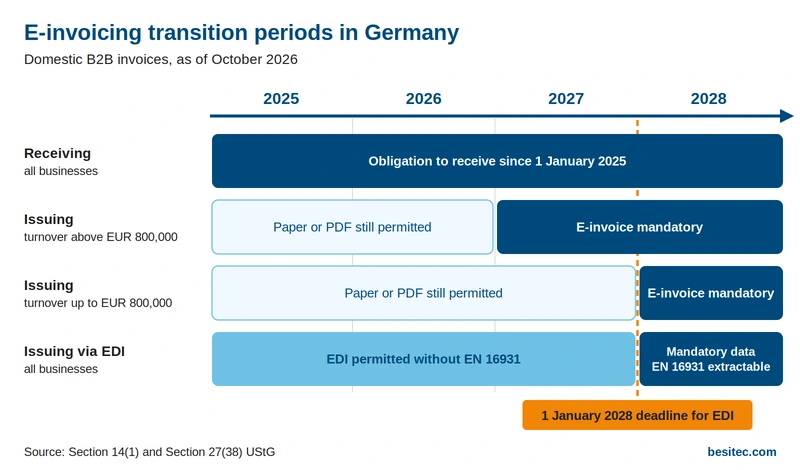
Since 1 January 2025, all businesses established in Germany must be able to receive e-invoices. For issuing invoices, staggered transition periods apply under Section 27(38) of the German VAT Act (UStG).
- Until 31 December 2026, all businesses may still issue other invoices, meaning paper or, with the recipient’s consent, PDF
- From 1 January 2027, businesses with total turnover above EUR 800,000 in the previous year must issue e-invoices. Turnover in 2026 is decisive
- Smaller businesses have until 31 December 2027
- From 1 January 2028, the obligation applies to all
Formats based on EN 16931 qualify as e-invoices, for example XRechnung or ZUGFeRD from version 2.0.1, excluding the MINIMUM and BASIC-WL profiles. A PDF is no longer an e-invoice.
For many mid-sized companies with EDI connections, this sounds like pressure at the turn of the year. For the EDI channel, however, a separate rule applies.
The EDI transition rule until 31 December 2027
German law includes a specific rule for established EDI procedures. For supplies made until the end of 2027, invoices may still be sent in a format that does not comply with EN 16931, provided they are transmitted via EDI and the recipient agrees. This applies regardless of company size.
In practice, a company with EUR 20 million turnover that currently sends its invoices to trading partners as EDIFACT INVOIC does not need to change this channel on 1 January 2027. Invoices to customers without an EDI connection, currently sent as PDF, must be issued as e-invoices from 2027.
For EDI users, 2027 is not a deadline but a buffer year.
Leave it unused, and you will face the same time pressure at the end of 2027 that others are facing now.
What applies to EDIFACT and e-invoicing from 1 January 2028
From 2028, the transition rule ends. EDI remains permitted nonetheless. Under Section 14(1) sentence 6 no. 2 UStG, trading partners may agree on another structured format, provided all data required under German VAT law can be transferred correctly and completely into a format that complies with or is interoperable with EN 16931. The German Federal Ministry of Finance (BMF) explicitly names EDI procedures such as EDIFACT.
What matters is not whether your EDI connection works, but whether your EDI invoice is complete.
The second BMF guidance of 15 October 2025 makes this even clearer. An invoice with format errors does not qualify as an e-invoice but as an other invoice. Once the transition periods have ended, this can put your customer’s input VAT deduction at risk. An invoice that arrives technically but does not contain the mandatory data in a properly structured form is therefore a risk for both sides.
Where EDI connections fall short in practice
Many EDI connections have grown over the years. They were built for one trading partner, not against a standard. The same gaps appear again and again when they are checked against EN 16931.
- Mandatory data sits in free text instead of the designated segments, for example the date of supply or the reason for a VAT exemption
- Partner-specific qualifiers and codes that only one recipient understands
- Missing or deviating code lists, for example for units of measure or tax categories
- Totals and rounding that do not match the calculation rules of the standard
- Credit notes and corrective invoices structured differently from the standard invoice
- Invoice attachments and additional information that only travel as text
The invoice arrives, the partner books it. The problem only becomes visible during validation or a tax audit.
Checklist for your EDI setup
- Which partners receive EDI invoices today, and which still receive PDF or paper?
- Is there an agreement on the procedure with every EDI partner?
- Is all mandatory data under Section 14(4) and Section 14a UStG included in structured form?
- Can every invoice type, including credit notes and cancellations, be validated against EN 16931?
- Who in your organisation is responsible when a partner changes its format?
How BESITEC takes EDI customers through the change
Your EDIFACT connection stays. Your partners change nothing.
We check your existing INVOIC messages against EN 16931 and show which data is missing or mapped incorrectly. Conversion into a compliant format then runs in the background on our EDI platform. In most cases, your part is limited to adding missing mandatory fields in your ERP system.
If a customer expects an XRechnung or delivery via Peppol instead of EDI, we handle this as a certified Peppol Access Point from the same data stream. You maintain one interface, not two.
You have one fixed contact from the first conversation to go-live. Hosting exclusively in Germany, certified to ISO/IEC 27001:2022.
You can check in advance whether your current invoice is compliant with our free XML visualiser.
Frequently asked questions
Do I have to switch off EDIFACT on 1 January 2027?
No. Invoices sent via EDI remain permitted until 31 December 2027 even without EN 16931 compliance, regardless of turnover.
Can I still use EDIFACT from 2028?
Yes, provided all VAT-relevant mandatory data can be transferred correctly and completely into an EN 16931-compliant format and the procedure has been agreed with the partner.
Does the EDI rule also apply to invoices to customers without EDI?
No. If you currently send PDFs and your prior-year turnover exceeds EUR 800,000, you must issue e-invoices from 1 January 2027.
What happens if an EDI invoice contains errors?
According to the BMF guidance of 15 October 2025, an invoice with format errors counts as an other invoice. After the transition periods, this puts the recipient’s input VAT deduction at risk.
Is switching to XRechnung enough?
Possibly, but often not necessary. In many cases, an existing EDI connection can be made compliant without your partners changing anything.
Conclusion
EDIFACT has a future in Germany, also under the e-invoicing mandate. The legislator has deliberately given EDI more time, not because the requirements are lower, but because adapting established connections takes more effort. Use 2027 to check your INVOIC messages against EN 16931 and the topic is closed by the end of the year. Wait until December 2027 and you will be negotiating with every partner under time pressure.
Our advice is to check your EDI invoices in the first half of 2027. How long the adjustment takes depends on the number of partners and invoice types.
For the general legal framework, read our article on e-invoicing in Germany.
Sources: Section 14 UStG, Section 27(38) UStG, BMF guidance of 15 October 2024 and 15 October 2025, as of October 2026.
This article does not constitute legal or tax advice. All information without guarantee, as of October 2026. For a binding assessment, please consult your tax adviser.
