
Malaysia E-Invoicing 2026: MyInvois Mandate Explained
Malaysia is implementing mandatory e-invoicing infrastructure by July 2026. All companies must validate electronic invoices through the government’s MyInvois platform.
Anyone working with Malaysian business partners or exporting to Asia should understand how the system works. In this article, we explain what MyInvois technically means, how integration works, and why German companies can stay relaxed – even without their own Malaysia subsidiary.
What is Malaysia E-Invoicing and MyInvois?
Malaysia E-Invoicing is the national clearance system for electronic invoices. The Malaysian tax authority IRBM (Inland Revenue Board of Malaysia) operates the central MyInvois platform, through which all e-invoices must be validated.
Technical Basics:
- Platform: MyInvois (https://myinvois.hasil.gov.my)
- Format: XML according to Malaysian specifications
- Integration: REST API, smartphone apps, web portal
- Validation: Real-time clearance with QR code
- Tax: Sales and Service Tax (SST) instead of VAT
MyInvois works similarly to Latin American e-invoicing systems: Every invoice must be validated by the tax authority before transmission to the recipient. After successful verification, the invoice receives a Unique Identifier Number (UIN) and a QR code for authenticity verification.
Why is Peppol Malaysia E-Invoicing relevant?
Malaysia has been rolling out a phased e-invoicing mandate since August 2024. Implementation follows company size:
Timeline:
- August 2024: Companies >RM 100 million annual revenue (~€22 million)
- January 2025: Companies >RM 50 million (~€11 million)
- July 2025: Companies >RM 25 million (~€5.5 million)
- January 2026: Companies >RM 500,000 (~€110,000)
- July 2026: All taxpayers, including B2C transactions
This means: From mid-2026, every company in Malaysia – regardless of size or industry – must process electronic invoices through MyInvois.
For German companies, this means:
- Malaysia becomes an important Asian market with e-invoicing mandate
- Similar timeline to German e-invoicing mandate (2027/2028)
- Synergies in EDI/e-invoicing infrastructure possible
- Preparation for additional ASEAN countries makes sense
Fun Fact: Malaysia is only the second Asian country after Singapore to establish Peppol as national e-invoicing infrastructure. Thailand and Vietnam are already evaluating similar systems.
Do German Companies Need to Use MyInvois?
Clear answer: No, not directly.
Foreign companies without a Malaysian subsidiary are not required to register with MyInvois or submit electronic invoices.
Two scenarios for German exporters:
Scenario 1: Export without e-invoicing integration
You export goods to Malaysia and send regular invoices (PDF, paper, EDI) to your Malaysian customer. The customer handles so-called self-billing:
- You create regular invoice in your ERP/SAP
- You send invoice via email/EDI to Malaysian customer
- Customer creates e-invoice for MyInvois based on your invoice
- Customer validates with MyInvois, receives UIN and QR code
- Customer pays – done
Important: The Malaysian partner bears compliance responsibility. You don’t need to change anything.
Scenario 2: Export with MyInvois integration
For regular deliveries or automated processes (e.g., container logistics, automotive supply chain), direct MyInvois integration can make sense:
- Your ERP/SAP creates invoice
- System sends data to EDI provider with MyInvois integration
- Provider converts to Malaysian XML format
- Automatic transmission via MyInvois API to IRBM
- IRBM validates and generates UIN + QR code
- Validated invoice goes to Malaysian partner
- Partner pays automatically
Advantage: Fully automatic end-to-end processes without manual rework at the partner.
How the integration works – Step by step
Variant A: Without Integration (Self-billing by Partner)
Process:
German Company
→ Create regular invoice (PDF/EDI)
→ Send to Malaysian partner
Malaysian Partner
→ Receive invoice
→ Create self-billed e-invoice for MyInvois
→ Validate with IRBM
→ Receive UIN + QR code
→ Process payment
Effort for German company: Zero. Everything runs as before.
Variant B: With Direct MyInvois Integration
Process:
German Company
→ Create invoice in ERP/SAP
→ Send data to EDI provider
EDI Provider
→ Convert to Malaysian XML
→ Add electronic signature
→ Send via MyInvois API to IRBM
IRBM (MyInvois)
→ Real-time validation
→ Generate UIN + QR code
→ Confirmation back to provider
EDI Provider
→ Validated invoice to Malaysian partner
→ Status message to German ERP
Effort: One-time integration, then automatic.
Alternative: Peppol and MY PINT
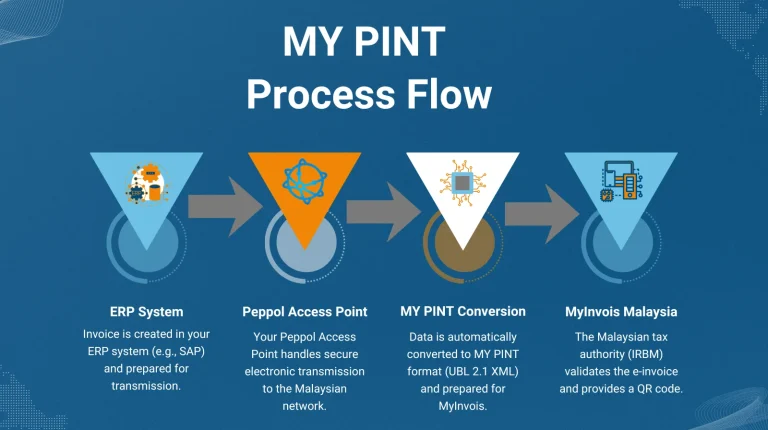
Besides direct MyInvois integration, there’s a second option: Peppol with the localized MY PINT standard (Malaysia Peppol International Invoice).
What is MY PINT?
MY PINT is the Malaysian variant of the global PINT standard (Peppol International Invoice). It’s based on OASIS UBL 2.1 XML and adapted for Malaysian tax requirements.
How does Peppol Malaysia work?
The Malaysia Digital Economy Corporation (MDEC) accredits Peppol Service Providers. These can exchange electronic invoices in MY PINT format via the Peppol network. The recipient then validates with MyInvois.
–learn more about how Peppol works globally.
Difference to Direct MyInvois Integration:
| Aspect | MyInvois Direct | Peppol MY PINT |
|---|---|---|
| Accreditation | Not required | MDEC accreditation (approx. €10,000) |
| Format | IRBM XML | UBL 2.1 (MY PINT) |
| Network | Point-to-point | Peppol network |
| EU Compatibility | Separate | One Access Point for EU + Malaysia |
| Effort | Low | Higher (two standards) |
For whom is Peppol suitable?
If you already use a Peppol Access Point for European business (German e-invoicing mandate from 2027/2028, Belgium, Poland, etc.) and your provider is MDEC-accredited, you can use the same access for Malaysia too.
Important: Not all European Peppol providers are accredited in Malaysia. Check beforehand whether your provider is MDEC-certified.
What else you need to know
Sales and Service Tax (SST) instead of VAT
Malaysia doesn’t use a VAT system like Europe, but SST (Sales and Service Tax). Tax rates and calculation fundamentally differ from German VAT. MyInvois is configured accordingly – your EDI provider must consider these differences in format conversion.
Container EDI meets E-Invoicing
Particularly interesting for logistics and maritime industries: Those already sending EDI messages to Malaysia (DESADV for delivery notes, IFTMIN for transport orders) can transmit e-invoices via the same infrastructure. One system for transport data AND invoices – that saves interfaces and complexity.
Consider Timeline
Plan sufficient lead time. Malaysia projects often need 3-6 months:
- Technical integration (API tests, formatting)
- Coordination with Malaysian partners
- Production launch and monitoring
- Troubleshooting for first invoices
Don’t wait until June 2026. Start planning by Q1 2026 at the latest.
Frequently Asked Questions about Malaysia E-Invoicing & MyInvois
Do I need a Malaysian tax number?
No. As a foreign supplier, you don’t need a Tax Identification Number (TIN) in Malaysia. Your partner uses a standard TIN for self-billing: “EI00000000030”
Can I continue using EDIFACT?
Yes. Internally, you can use EDIFACT, SAP IDoc, or other formats. Your EDI provider converts to Malaysian XML when needed. Similar to sending DESADV to SAP – different formats, one transmission channel.
How long does validation at MyInvois take?
Usually a few seconds to minutes. MyInvois operates as a clearance platform in real-time – similar to Latin American e-invoicing systems (Mexico, Brazil, Chile).
What happens if validation fails?
MyInvois returns a detailed error code (e.g., invalid tax number, missing mandatory field). Your system or EDI provider automatically corrects and resends. For self-billing by partner: Partner fixes the problem.
Does my German ERP system work with MyInvois?
Yes, through an EDI provider as middleware. SAP, DATEV, Microsoft Dynamics, and other ERP systems can be connected via standardized interfaces. You don’t need to rebuild your ERP – just configure the connection.
BESITEC Approach: Direct MyInvois Integration
At BESITEC, we focus on direct integration with the MyInvois platform (IRBM) – pragmatically via existing EDI infrastructure, without additional Peppol accreditation.
Our approach:
- Direct SAP/ERP connection to MyInvois REST API -– similar to our S/4HANA EDI approach
- Automatic format conversion to Malaysian XML
- Electronic signature according to IRBM specifications
- QR code generation for authenticity verification
- One system for German e-invoicing mandate + international partners
Whether automated from ERP or manually via web.edi interface – the main thing is that your e-invoice arrives securely and compliantly at your Malaysian partner.
Particularly relevant for industries with regular Asia business:
- Automotive (suppliers, just-in-time deliveries)
- Chemicals (container export, long-term supply contracts)
- Mechanical engineering (spare parts, maintenance contracts)
- Container logistics (Hamburg as Asia gateway)
Why no Peppol MY PINT integration at BESITEC?
MDEC accreditation as a Peppol Service Provider requires significant investments (approx. €10,000 certification) and ongoing compliance effort. For most German mid-market companies, direct MyInvois integration is the more pragmatic way – without additional network complexity.
If you already use an MDEC-accredited Peppol provider, you can of course take the Peppol route. We focus on what works best for 95% of our customers: Direct API integration.
Conclusion: Malaysia E-Invoicing – Compliance Without Headaches
Malaysia E-Invoicing becomes mandatory by July 2026 – but German exporters can stay relaxed. The self-billing option relieves foreign companies of direct compliance pressure.
For companies with regular Malaysia business, MyInvois integration is still worthwhile: Fully automatic processes, no manual rework at the partner, continuous digitalization from order to payment.
The key takeaways:
- Self-billing works: Malaysian partner handles e-invoicing
- Direct MyInvois integration: For automation and efficiency
- Peppol MY PINT: Alternative with existing Peppol access
- Consider timeline: Start planning by Q1 2026 at latest
Malaysia is the kickoff – Thailand, Vietnam, and Indonesia are evaluating similar systems. Those building infrastructure now are prepared when additional ASEAN countries introduce e-invoicing mandates.
Are you planning Malaysia integration or have questions about MyInvois?
BESITEC has been supporting international EDI and e-invoicing projects for over 20 years. Contact us.
